Artificial Intelligence in Lung Cancer: Hope vs. Hype

Artificial intelligence (AI) is rapidly reshaping the future of cancer care, but such dramatic innovation also brings important questions. AI has evolved from early consumer tools (like autocorrect on phones, customer service chatbots, and personalized shopping recommendations) to advanced systems with the potential to revolutionize biomedical discovery and patient care. While there is tremendous excitement around AI, there is also a critical need to use it responsibly. Researchers are actively studying how to implement AI across the lung cancer continuum. Key areas of focus include improving

Why Immunotherapy Isn’t Perfect & How Scientists Are Working to Fix It

The human immune system is an intricate web of checks and balances that usually excels at detecting and destroying foreign invaders, such as bacteria and viruses, while protecting healthy tissue. But sometimes, the checks and balances get confused and stop the immune system from doing what’s right—such as killing tumor cells. Tumor cells are good at confusing the immune system because they originate from our healthy cells. They can often avoid detection by immune cells. Through several decades of research, we have identified two key protein pathways, PD-L1 and CTLA-4, that lung cancer cells

Biggest News from Berlin: Research Highlights from ESMO

Lung cancer research was in the spotlight at the European Society for Medical Oncology (ESMO) meeting held October 17-21, 2025, in Berlin, Germany. With approximately 30,000 attendees from over 100 countries, this meeting gathered an international audience of clinicians, researchers, patient advocates, and representatives from the healthcare industry to discuss cutting-edge cancer research and share practice-changing clinical trial data. We saw data from studies that aim to build upon existing treatments, to optimize combination approaches, and to address some of the unmet needs of people

New Accelerated Approval for HER2-positive NSCLC

On November 19, 2025, the US Food and Drug Administration (FDA) announced the accelerated approval of sevabertinib (Hyrnuo®) to treat patients with locally-advanced or metastatic non-small cell lung cancer (NSCLC) with specific mutations in the HER2 gene. This approval is for patients who have been previously treated with HER2-targeted therapies, as well as patients who have received previous treatment that did not target HER2. Mutations in the HER2 gene (also called the ERBB2 gene) are responsible for approximately 2%-3% of nonsquamous NSCLCs. These mutations activate the HER2 protein and

New Insights in Treating Metastatic Lung Cancer from WCLC 2025

For people with advanced or metastatic non-small cell lung cancer (NSCLC), the treatment landscape has changed dramatically in recent years. Researchers are learning how to optimize existing therapies and are exploring entirely new treatment approaches. At the 2025 World Conference on Lung Cancer (WCLC), several studies highlighted progress in treating newly diagnosed individuals as well as those who need new options after standard therapies stop working. Combining Chemotherapy and Targeted Therapy to Treat EGFR-positive Lung Cancer One of the most anticipated studies at WCLC was the phase 3

First Oral Targeted Therapy Approved for Advanced HER2+ NSCLC

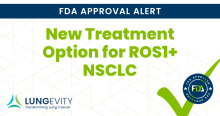
On August 8, 2025, the US Food and Drug Administration (FDA) announced the accelerated approval of zongertinib (Hernexeos®) to treat patients with unresectable or metastatic non-small cell lung cancer (NSCLC) with mutations in the HER2 gene. This approval is for patients who have been previously treated with a systemic therapy (such as chemotherapy). Mutations in the HER2 gene (also called the ERBB2 gene) are responsible for approximately 2-3% of nonsquamous NSCLCs. These mutations activate the HER2 protein and drive cancer growth. Zongertinib is a type of targeted therapy that is given as a

Surviving LMD: Michelle Never Settled for “No”

Michelle knew what was wrong. She knew the headaches, regular vomiting, ear popping, and “whooshing” sounds in her head were all signs of leptomeningeal disease (LMD). The issue, however, is that LMD is so rare—only diagnosed in 5% of people with cancer—she had to advocate for the testing to prove it. “I called my clinic and said I needed a brain MRI because I think I have LMD. They didn’t want to schedule one, so I said, tell my doctor I’m demanding a brain MRI. I can tell him directly if I need to,” says Michelle. Leptomeningeal disease, or LMD, occurs when cancer from somewhere in the body

What Are Antibody-Drug Conjugates and How Do They Treat Lung Cancer?

Historically, approaches to treating lung cancer included surgery, radiation, and chemotherapy. The past decade ushered in a new era of treatments with targeted therapy and immunotherapy. Now, we are seeing the emergence of another class of lung cancer treatments called antibody-drug conjugates (ADCs), that are a combination of targeted therapy and chemotherapy. ADCs act like a “smart chemotherapy” that aim to deliver the drug compound directly to cancer cells, reducing harm to healthy tissue. As part of LUNGevity’s International Lung Cancer Survivorship Conference last September, we hosted an

Integrative Oncology and Lung Cancer: Adding Complementary Therapy

What Is Integrative Oncology? Integrative oncology is the use of complementary therapies alongside conventional lung cancer treatments like chemotherapy, targeted therapy, surgery, or immunotherapy. Integrative oncology—also called integrative medicine—is an evidence-informed whole-body approach to health. It is often used to address symptoms and side effects caused by disease or treatment and improve overall quality of life. Specific examples of integrative oncology for lung cancer include: Acupuncture or massages to address pain or nausea Exercise to reduce pain and improve overall quality

What Should Patients Know About Lung Cancer Surgery?

Surgery is a treatment option for early-stage lung cancer that involves removing all or part of a lung to treat a cancerous tumor. It is primarily an option for people with non-small cell lung cancer (NSCLC) staged at I, II, or IIIA. Surgery is rarely considered for tumors at stage IIIB or IV because those lung cancers have spread to other parts of the body. It is also rarely used to treat small cell lung cancer (SCLC) because SCLC is typically diagnosed at a later stage. Types of Lung Cancer Surgery Once the medical team decides someone’s lung cancer is resectable (able to be removed by