Watch HOPE Summit 2026 Videos

HOPE Summit 2026 was filled with old friends reuniting, new friends being made, and of course, plenty of inspirational and informative sessions designed to help people live well with lung cancer. For the second year in a row, select sessions were recorded so those who could not attend are still able to access the valuable information shared. HOPE Summit 2026 Recorded Sessions Keynote: Wagons Roll with Dr. Ross Camidge Back in the Saddle: Reclaiming Strength and Living Well Charting New Territory with Palliative Care Partners Community Connections Across the Horizon Experts Around the Campfire

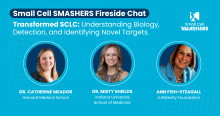
Small Cell SMASHERS Fireside Chat with Dr. Catherine Meador

In April, we were joined by Catherine Meador, MD, PhD, assistant professor of medicine at Harvard Medical School. Dr. Meador discussed Transformed SCLC: Understanding Biology, Detection, and Identifying Novel Targets. Moderated by Misty Shields, MD, PhD, Indiana University School of Medicine, and LUNGevity’s Ann Fish-Steagall, RN, BSN, SVP of Patient Services and Health Care Delivery, the monthly Small Cell SMASHERS series highlights the latest discoveries and breakthroughs for SCLC.

Podcast: Lung Cancer Diagnosis—What Happens Next

What happens after a lung cancer diagnosis? In this first episode of LUNGevity’s Lung Cancer Voices of Hope podcast, lung cancer survivor Lisa Bistline shares her experience, from initial scans and biopsies through multiple treatments, and the moment a later biopsy revealed a biomarker that led to a targeted therapy. Hosts Ann Steagall and Misty Shields, MD, PhD, then speak with Anne Chiang, MD, PhD, thoracic oncologist at Yale University, about what patients can expect at their first visit, including how doctors determine the type and stage of cancer, plan treatment, and approach care

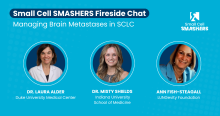
Small Cell SMASHERS Fireside Chat with Dr. Laura Alder

In March, we were joined by Laura Alder, MD, assistant professor of medicine in the Division of Medical Oncology at Duke University Medical Center, to discuss the topic of managing brain metastases in SCLC. Moderated by Misty Shields, MD, PhD, Indiana University School of Medicine, and LUNGevity’s Ann Fish-Steagall, RN, BSN, SVP of Patient Services and Health Care Delivery, the monthly Small Cell SMASHERS series highlights the latest discoveries and breakthroughs for SCLC.

Initial Treatment Options for HER2+ NSCLC Expand with New Zongertinib Approval

On February 26, 2026, the US Food and Drug Administration (FDA) announced the accelerated approval of zongertinib (Hernexeos®) as an initial treatment option for newly diagnosed patients with advanced non-small cell lung cancer (NSCLC) with mutations in the HER2 gene. This approval expands the usage of this treatment from August 2025 when it was only approved for patients who have been previously treated with a systemic therapy (such as chemotherapy). Mutations in the HER2 gene (also called the ERBB2 gene) are responsible for approximately 2%-3% of nonsquamous NSCLCs. These mutations activate

Artificial Intelligence in Lung Cancer: Hope vs. Hype

Artificial intelligence (AI) is rapidly reshaping the future of cancer care, but such dramatic innovation also brings important questions. AI has evolved from early consumer tools (like autocorrect on phones, customer service chatbots, and personalized shopping recommendations) to advanced systems with the potential to revolutionize biomedical discovery and patient care. While there is tremendous excitement around AI, there is also a critical need to use it responsibly. Researchers are actively studying how to implement AI across the lung cancer continuum. Key areas of focus include improving

Why Immunotherapy Isn’t Perfect & How Scientists Are Working to Fix It

The human immune system is an intricate web of checks and balances that usually excels at detecting and destroying foreign invaders, such as bacteria and viruses, while protecting healthy tissue. But sometimes, the checks and balances get confused and stop the immune system from doing what’s right—such as killing tumor cells. Tumor cells are good at confusing the immune system because they originate from our healthy cells. They can often avoid detection by immune cells. Through several decades of research, we have identified two key protein pathways, PD-L1 and CTLA-4, that lung cancer cells

Biggest News from Berlin: Research Highlights from ESMO

Lung cancer research was in the spotlight at the European Society for Medical Oncology (ESMO) meeting held October 17-21, 2025, in Berlin, Germany. With approximately 30,000 attendees from over 100 countries, this meeting gathered an international audience of clinicians, researchers, patient advocates, and representatives from the healthcare industry to discuss cutting-edge cancer research and share practice-changing clinical trial data. We saw data from studies that aim to build upon existing treatments, to optimize combination approaches, and to address some of the unmet needs of people

Small Cell SMASHERS Fireside Chat with Dr. Trudy Oliver

In November, Trudy Oliver, PhD, professor of pharmacology and cancer biology at Duke University School of Medicine and Duke Cancer Institute, discussed the origins of small cell lung cancer (SCLC) and its impact on plasticity. Moderated by Dr. Misty Shields, Indiana University School of Medicine, and LUNGevity’s Ann Fish-Steagall, SVP of Patient Services and Health Care Delivery, this monthly virtual series highlights the latest discoveries and breakthroughs for SCLC.

New Accelerated Approval for HER2-positive NSCLC

On November 19, 2025, the US Food and Drug Administration (FDA) announced the accelerated approval of sevabertinib (Hyrnuo®) to treat patients with locally-advanced or metastatic non-small cell lung cancer (NSCLC) with specific mutations in the HER2 gene. This approval is for patients who have been previously treated with HER2-targeted therapies, as well as patients who have received previous treatment that did not target HER2. Mutations in the HER2 gene (also called the ERBB2 gene) are responsible for approximately 2%-3% of nonsquamous NSCLCs. These mutations activate the HER2 protein and